
Most DTC brands do not have a creative strategy problem. They have a creative strategy ownership problem. Someone is making ads, someone is buying media, and nobody is responsible for the thinking in between: what the next 10 ads should say, why, to whom, and how you will know if they worked.
The symptoms are familiar. Winning ads get copied until they fatigue. New concepts arrive because the editor had an idea, not because the data pointed somewhere. Testing happens, but nobody can say what was learned.
The fix is rarely more assets. It is a person, or a small group of people, whose job is to own that layer. The question is where that person sits. Each option has a real cost and a real limit, and the right answer changes with your stage, your spend and how much of the work you already do well.
This piece lays out 7 ways to staff it. It is a guide to the types, not a ranking of firms. We run one of them ourselves, and we say so where it comes up.
The short version
- Spending seriously, need everything handled, can pay for it: a full-service agency or a performance creative agency, chosen by how much production you need bundled in.
- Spending enough to justify a salary and planning to keep spending: an in-house creative strategist, ideally hired before the creative team gets big.
- Have a media buyer and a few makers but nobody owning the thinking: a fractional creative strategist, or a first in-house hire if the volume is steady.
- Early, small budget, founder still close to the customer: founder-led, with a freelancer marketplace for the making, until the founder's time becomes the bottleneck.
- Whatever you choose: one named person owns the brief, the test plan and the read-out. If those live in 3 places, you have not staffed creative strategy.
Quick comparison
| Model | Suits | Watch out for |
|---|---|---|
| Full-service agency | Brands with real budget, a lean team, wanting one contract for everything. | Thinking may be thin and distant; ask who owns it by name. |
| Performance creative agency | Brands spending enough that creative is the main lever. | Volume pressure can turn variety into many versions of one idea. |
| In-house creative strategist | Brands with steady spend, stable products, enough output to stay busy full-time. | Hard to hire well, and one person's blind spots become the brand's. |
| In-house team with a media buyer only | A reasonable stop when spend is modest and the product is simple. | Strategy gets done in the gaps; briefs become copy the winner. |
| Freelancer marketplace | Early brands whose founder or marketer can direct the work and brief. | No shared memory across freelancers; the testing log gets lost. |
| Fractional creative strategy studio | Brands with production and media covered, missing the layer that directs them. | A studio spread across too many brands loses the fractional shape. |
| Founder-led | Pre-scale brands where the founder still talks to customers weekly. | Growth strains the founder's attention; makers start guessing without a brief. |
The detail on each model is below.
How we compared them
Each model is described on the same 4 points: what it covers, what it costs you beyond the invoice, who it suits, and where it breaks. We have not attached price figures. Rates vary too much by market, spend and scope, and a made-up range would do more harm than good.
One definition first. By creative strategy we mean the layer between the ad account and the creative team: research into the customer and the category, concepts and angles built from that research, briefs the makers can execute, a testing plan, and the analysis that turns results into the next round. Production (editing, design, filming) and media buying (building and managing campaigns) are different jobs. Some of the models below bundle all three. Some bundle none.
The 7 models
1. Full-service agency
What it covers. Strategy, production and media buying under one roof, usually with account management on top. You get a team, a process and a monthly deck.
What it costs you beyond the fee. Distance. The people doing the thinking are several layers from your customer and from you. Briefs pass through account managers, and feedback comes back the same way. And if the fee scales with spend or output, you will be nudged to spend more or make more, which is not the same as making better.
Who it suits. Brands with a real budget, a lean internal team, and a preference for one contract over several. Also brands that need capacity fast and can afford to buy it.
Where it breaks. The strategy layer is often the thinnest part of the offer, because production and media are what the agency is set up to bill. Ask who, by name, owns the creative thinking on your account.
2. Performance creative agency
What it covers. Creative built for paid social, with strategy and testing baked in. Typically concepts, scripts, briefs, production (often through a creator network) and a reporting loop with your media buyer. Media buying is sometimes included.
What it costs you beyond the fee. Volume pressure. Many of these agencies sell a number of assets per month, which pushes the work toward quantity. Meta's own guidance on creative diversification describes the goal as "creating a wide range of ad creatives with different themes, messages, and visuals." That is a variety problem, not a volume problem, and a monthly asset count can quietly become 12 versions of one idea.
Who it suits. Brands spending enough on paid social that creative is the main lever, without the desire to build a creative team in-house. Works best when you have a strong media buyer who can hold the agency to a test plan.
Where it breaks. When the agency also produces the assets, it marks its own homework. Ask how they decide what to make next, and whether that decision comes from your account data or from their template library.
3. In-house creative strategist
What it covers. One person, employed by you, who owns research, concepts, briefs, testing and analysis, and works daily with your media buyer and your makers.
What it costs you beyond the salary. Management, tools and a career path. Good strategists want to grow, and in a small brand there is nowhere to grow into. Expect to lose them to a bigger brand or an agency unless the role expands. There is also a single point of failure: one person's blind spots become the brand's blind spots.
Who it suits. Brands with steady spend, a stable product range and enough creative output to keep someone busy full time. Also brands where the customer is specialised enough that continuous immersion beats breadth of experience.
Where it breaks. Hiring. The title is young and the market is uneven. Many candidates are media buyers who write briefs, or creatives who read dashboards, and neither is quite the job. Ask candidates to walk you through a test they ran: what they expected, what happened, what changed next. That tells you more than a portfolio.
4. In-house team with a media buyer only
What it covers. The most common setup we see, and the one most brands do not realise they are running. There is a media buyer, an editor or designer, maybe a creator or two. The media buyer ends up owning creative strategy by default, because they are the one looking at the numbers.
What it costs you. The strategy gets done in the gaps. Media buyers are optimising campaigns, managing budgets, chasing tracking issues. Concepting from customer research is not what they were hired for or measured on. So the briefs become "make more like the winner," and the makers fill in the rest from taste.
Who it suits. Nobody as a permanent state, but it is a reasonable stop on the way. If spend is modest and the product is simple, it can run for a while.
Where it breaks. The moment the winning ad fatigues and there is no pipeline behind it. Or the moment you enter a new market and nobody has done the research. If you recognise this setup, the question is whether to add a strategist in-house, fractionally, or through an agency. Not whether to add one.
5. Freelancer marketplace
What it covers. Individual strategists, editors, designers and creators, hired by the project or the month through a platform. You assemble the team and manage it yourself.
What it costs you beyond the rate. Your time. Every freelancer needs a brief, a check-in and a review, and none of them share context unless you build it. Quality varies, and the platform's ratings tell you about reliability more than about judgement. You will also carry the strategy layer yourself unless you specifically hire a strategist, which most brands on marketplaces do not.
Who it suits. Early brands with a founder or marketer who can direct the work and knows what a good brief looks like. Also brands that need a specific skill for a short window, such as a batch of statics before a launch.
Where it breaks. Scale and continuity. When you are testing weekly across 2 platforms and 4 products, a rotating cast with no shared memory produces inconsistent work and no compounding learning. Ask who holds the testing log. If nobody does, the marketplace is holding you back.
6. Fractional creative strategy studio
What it covers. A senior strategist, or a very small team of them, working with several brands at once for a fixed portion of their time. They own the thinking: research, concepts, briefs, testing plan, analysis. They brief your makers and hand approved work to your media buyer. They do not produce assets and usually do not buy media.
What it costs you beyond the fee. You need makers and a media buyer already in place, or the willingness to get them. A fractional strategist with nobody to brief is a consultant writing documents. You also get part of a person's week, not all of it.
Who it suits. Brands that have production and media buying covered and are missing the layer that directs them. Often this is the brand from model 4: a buyer, an editor, some creators, and a winner starting to fade. Also brands that would rather pay for senior judgement than for output.
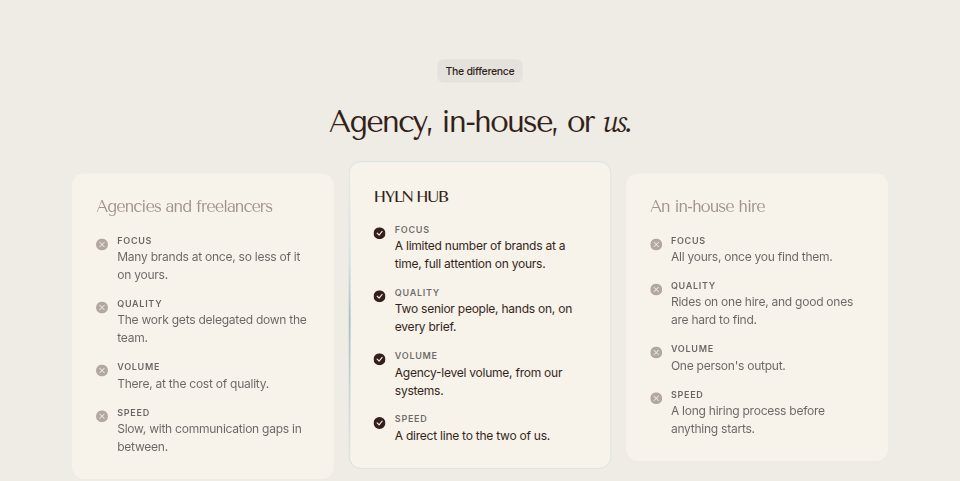
Where it breaks. Capacity. A studio that takes on too many brands stops being fractional and becomes an agency without the infrastructure. Ask how many brands they work with at once, and who exactly will be on your account. This is the model we run at HYLN Hub: 2 senior strategists, a limited number of brands, no production team. We think it is the right shape for a specific kind of brand and the wrong one for others. Weigh that when you read this section.
7. Founder-led
What it covers. The founder, or an early marketer, does the strategy themselves. Concepts come from conversations with customers, reviews and support tickets. Briefs are short and informal. Testing is fast because there is no approval chain.
What it costs you. The founder's attention, the scarcest resource in the company. Also rigour: without a process, learnings live in someone's head and get lost. And founders are often too close to the product to see how a stranger reads the ad.
Who it suits. Pre-scale brands where the founder still talks to customers weekly and paid social is one of several channels. At this stage founder-led is usually the best option, because nobody else knows the customer as well.
Where it breaks. Growth. Spend goes up, the founder's calendar fills, and creative strategy becomes a Sunday-night activity. The tell is when the makers start guessing because the brief did not come. The choice then is in-house, fractional or agency, and it depends mostly on whether the founder wants to stay involved in the creative or step away from it.
Which model fits your stage
A rough map, not a rule.
Before product-market fit. Founder-led, with freelancers for production. Anything more is paying for structure you do not need yet. Keep a log of every ad, what it said, and what happened.
First real scale on paid social. This is where the gaps show. If the founder wants to keep directing creative, add production capacity and keep the thinking in-house. If the founder wants out of the day-to-day, bring in a strategist, in-house or fractional, before the creative team grows around a vacuum.
Steady spend, multiple products or markets. You need someone whose whole job is the strategy layer. In-house if you can hire and retain well and the volume is constant. Fractional if the volume is variable, if you want senior judgement rather than junior hours, or if you have been burned hiring for a role the market has not settled on yet.
High spend, lean internal team. A full-service or performance creative agency is the fastest route to capacity. Insist on knowing who owns the thinking, and keep your own testing log so the learnings stay yours if the agency changes.
2 moves are almost always wrong: hiring a creative team before anyone owns the strategy, and asking the media buyer to carry the strategy layer indefinitely. The second works until it does not, and it usually fails during a scaling push.
What to ask before you choose
The same questions apply to every model. The answers tell you whether creative strategy is being staffed or just being mentioned.
Who, by name, owns the brief? Not the team, not the process. A person. If the answer is a team, ask who signs off.
Where do new concepts come from? The right answer involves your customers, your account data and your competitors' ads, in roughly that order. The wrong answer is "our creative team" or "trends."
What does a test look like? Ask for a real example: hypothesis, what was made, what happened, what changed next. Anyone who has run a testing loop can answer this in 2 minutes.
How is the work handed to the media buyer, and what comes back? Creative strategy that does not close the loop with the ad account is just concepting. You want to hear about naming, tracking and a regular read-out.
How many other brands does this person carry? There is a number above which attention thins out. Ask for it.
What happens to the learnings if we stop working together? The testing log, the research, the concept library. If it leaves with the partner, you have rented your own knowledge.
Working with HYLN Hub
HYLN Hub is a fractional creative strategy studio for DTC brands in wellness, supplements, beauty, skincare and lifestyle, based in Barcelona and working with brands in Europe and the U.S. We are 2 senior strategists. We do the research, the concepts, the briefs, the testing and the analysis, and we direct your editors, designers and creators. We do not produce assets or buy media. If your brand has the makers and the media buyer and is missing the layer that directs them, that is the shape we work with. You can tell us about your brand here.
FAQ
Do I need a creative strategist if I already have a good media buyer?
Probably, if paid social matters to you and spend is growing. A media buyer is measured on the account, not on the pipeline of ideas behind it. The 2 roles overlap in reading data and diverge in what they do with it. If your buyer is already doing research and writing structured briefs, ask how long they can sustain it.
Is fractional just a nicer word for freelance?
Not quite. A freelancer is usually hired for a task or a deliverable. A fractional strategist is hired for a standing portion of their time and owns an ongoing function, including the parts that produce no deliverable, like reading results and deciding what not to make. The label matters less than who owns the thinking, so ask that.
How do I judge a creative strategist's work before results come in?
Look at the briefs and the test plan. A good brief names the audience, the angle, the reason to believe and what the ad has to achieve, and a maker who has never met the strategist can execute it. A good test plan says what is being tested, what counts as a win, and what happens either way. If those 2 documents are sharp, results usually follow. If they are vague, no result will teach you anything.